
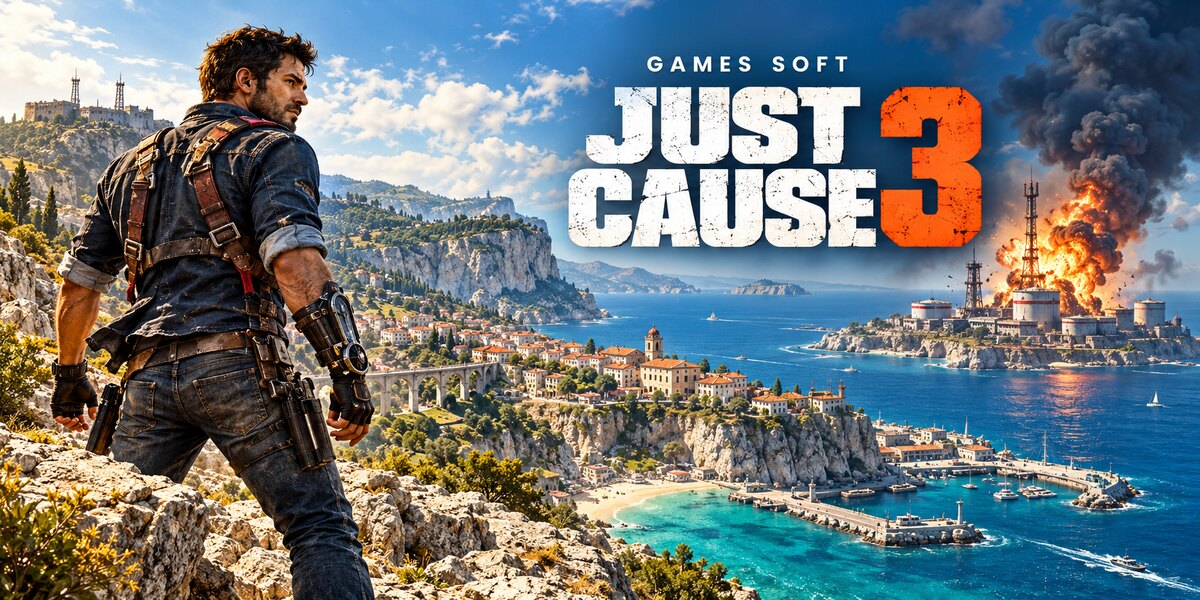
GAMES SOFT – There is something compelling about a game that gives you room to try an outrageous idea and lets its world react. A journey toward an enemy base can turn into a helicopter hijacking. A planned ground assault can become an airborne entrance. In Just Cause 3, these sudden changes of plan are part of the appeal.

Developed by Avalanche Studios, this open-world action game places Rico Rodriguez at the center of a struggle to liberate Medici. Its appeal extends well beyond the mission to overthrow a dictator. Just Cause 3 provides vehicles, gadgets, and environments that encourage experimentation. Together, they create an adventure that feels like an action movie in which the player gets to direct the next scene.
Medici: Beautiful Islands with a Troubled Past
Medici holds a personal connection for Rico. He returns to the place where he grew up to confront Sebastiano Di Ravello, the ruler responsible for his family’s tragedy and his years in exile. That history gives Rico a reason to join the people’s struggle and ties the central conflict to his own life.
The landscape supports the scale of this adventure. Steep cliffs, tunnels, and underground facilities create spaces that players can explore from different directions. A wide selection of land, sea, and air vehicles connects the various parts of the world.
From a design perspective, these locations serve practical purposes throughout the journey. A cliff can become a starting point for an aerial approach. Higher ground offers an opportunity to inspect an area before moving closer. Even a destination that looks distant on the map raises an inviting question: which route would be the most enjoyable to take?
That question helps explain Medici’s appeal. Its open world gives players room to choose how they move, decide which risks to take, and discover entertainment between objectives.
Three Gadgets That Transform Exploration
Just Cause 3 builds much of its identity around the combination of the grappling hook, parachute, and wingsuit. The grappling hook helps Rico pull himself toward a chosen point. The parachute provides control in the air, while the wingsuit enables faster gliding. Avalanche designed these tools to work together as a central part of the game’s freedom of movement.
Their appeal comes from how their functions complement one another. Players learn to read their position, altitude, and direction before choosing the tool that suits the moment. Traveling becomes a challenge of its own: how can you maintain a smooth sequence of movements while approaching your destination?
For newcomers, trying to master everything at once can feel overwhelming. A more comfortable approach is to practice one simple transition, then introduce another once the controls become familiar. An open area provides space to focus on movement without too many distractions.
It is also useful to distinguish the standard wingsuit from the weaponized Bavarium Wingsuit. The latter is introduced through the Sky Fortress DLC. Understanding that difference makes it easier to identify which features belong to the base game when watching videos or reading guides.
The Grappling Hook Makes the World Feel Full of Possibilities
The grappling hook deserves particular attention because its usefulness extends beyond transportation. It can connect objects, help Rico hijack vehicles, and provide creative ways to cause destruction. These capabilities are among the features the developer highlights as tools for player experimentation.
This changes how players look at their surroundings. When a tool can connect two objects and affect their movement, positioning becomes interesting. Something that initially appears to be background decoration may become part of an idea worth testing.
This is one of the clearest strengths of the game’s design. A single tool produces numerous possibilities because it works across many situations. Players have a reason to pause, observe the environment, and try an approach inspired by curiosity.
An experiment does not have to work perfectly to be entertaining. A plan that changes halfway through can encourage a spontaneous decision. That room for improvisation gives both combat encounters and ordinary journeys their own character.
Liberating Territory on Your Own Terms
Rico’s campaign involves attacking the facilities and symbols that sustain Di Ravello’s control. Military bases, statues, propaganda billboards, and loudspeakers form part of the regime’s presence across Medici. Destroying these targets contributes to weakening its authority and liberating territory.
The freedom to choose an approach makes this process worth exploring. In an official guide, the game’s senior producer recommends surveying a location before attacking. Certain antiaircraft defenses, for example, can be hacked and turned against enemy helicopters. The environment offers opportunities that reward a little observation.
For a new player, taking a moment to inspect an area can help prevent rushed decisions. Identify the targets, look for places to reposition, and consider how to leave if the situation becomes difficult. A simple plan provides direction while leaving plenty of room for improvisation.
Liberating locations can become repetitive when every encounter is approached in exactly the same way. Variety therefore matters. Changing your vehicle, arrival angle, or equipment provides a way to practice different skills while working toward a familiar objective.
Challenges That Give You a Reason to Keep Learning
Just Cause 3 links territorial liberation to the availability of various challenges. These activities test your handling of vehicles, weapons, and gadgets. Performance earns Gears, which contribute to unlocking upgrades through the Gear Mods system. These upgrades are built into the game and can be switched on or off.
The connection between challenges and upgrades gives players a reason to develop their basic skills. Better movement control or a clearer understanding of a particular tool can prove useful well beyond a single attempt. Practice becomes part of the game’s progression.
However, chasing the best possible result immediately can make learning feel exhausting. A more manageable approach is to give each attempt a small goal: understand the course, recognize a recurring mistake, or complete a section that previously caused trouble. These improvements are easier to notice than progress measured only against the highest score.
This approach can also help maintain an enjoyable pace. Challenges provide a change of focus between exploration and missions, allowing players to alternate between different activities.
Vehicles and Preparation Expand Your Options
Just Cause 3 includes speedboats, jets, helicopters, sports cars, and motorcycles. That variety lets players approach Medici by land, sea, or air, with each method offering a different way to experience the landscape.
Rebel Drops provide another way to prepare. The official guide explains that eligible vehicles collected through garages can be called in using this feature. Weapons can also be delivered to help Rico handle difficult situations.
These options make preparation more flexible. When one approach feels unsuitable, players can change their equipment and try something else. A difficult encounter becomes an opportunity to reconsider a decision and explore another possibility.
To enjoy that process, occasionally choose a vehicle simply because you are curious about it. Notice how changes in speed and perspective affect the way you read the environment. Even a trip to a familiar destination can acquire a different atmosphere when you change how you travel.
Finding Adventure Between Objectives
The appeal of Just Cause 3 becomes clearest in the freedom players have to shape their journeys. Missions provide direction, while the equipment and environment create possibilities along the way.
For players who enjoy experimenting, this combination offers a reason to return with another idea. Those who prefer a tightly guided experience may need to adjust their expectations to the amount of improvisation the game encourages.
Medici invites you to wander from your original plan occasionally. Practicing a glide, trying an unfamiliar vehicle, or finding a different entrance can become as engaging as reaching the objective itself. Given enough curiosity, even a short journey can develop into a sequence of action worth talking about.